8 Best WhatsApp Chatbots for Ecommerce: Complete 2026 Comparison Guide
Best WhatsApp chatbots for ecommerce in 2026 include TextYess, Tidio, and ManyChat. Compare 8 AI platforms for automated sales, cart recovery, and support.
Best WhatsApp chatbots for ecommerce in 2026 include TextYess, Tidio, and ManyChat. Compare 8 AI platforms for automated sales, cart recovery, and support.
Most ecommerce brands treat WhatsApp as a support channel: a place to answer questions after something goes wrong. The brands growing fastest in 2026 have figured out something different: WhatsApp conversations are where sales happen now.
When a shopper can ask about sizing, get a personalized recommendation, and complete their purchase without leaving the chat, the path from interest to transaction shrinks dramatically. This guide compares the eight leading WhatsApp chatbot platforms for ecommerce, breaks down the features that actually drive revenue, and walks through how to choose the right one for your store.
The best WhatsApp chatbots for ecommerce in 2026 are AI-powered platforms like TextYess, Tidio, and ManyChat that connect directly to online stores, enabling automated conversations for sales and support around the clock. A WhatsApp AI Agent is an automated messaging assistant that operates through the WhatsApp Business API: handling product questions, recommending items, and guiding shoppers from browsing to checkout without human intervention.
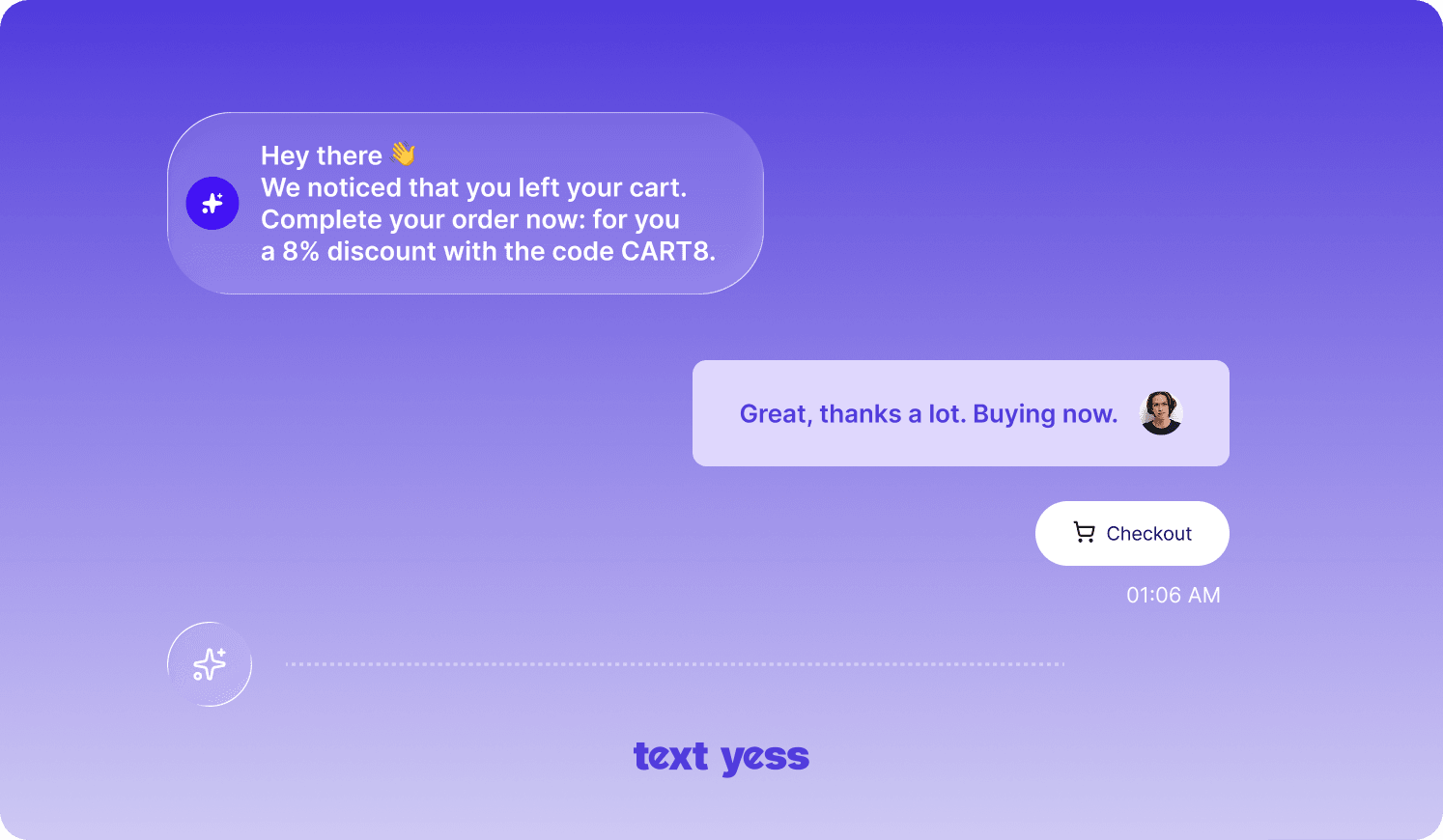
Among the platforms built specifically around this sales-first approach, TextYess is designed to close the gap between conversation and conversion. Where many tools treat WhatsApp as a support inbox, TextYess deploys AI Agents that proactively launch conversations— abandoned cart recovery, personalized product recommendations, post-purchase follow-ups— using real-time data synced directly from your store.
Every interaction is managed in a unified inbox alongside on-site chat and WhatsApp, so your team sees the full customer picture without switching tools. Revenue attribution ties each conversation to actual orders, giving you a clear view of what's driving results rather than just message volume. For EU brands managing multi-language traffic, conversations adapt automatically to each customer's language preference. Setup is no-code and takes minutes, not weeks.
Book a demo with TextYess to see how it performs against your current setup.
What makes a WhatsApp chatbot valuable for online stores comes down to four core capabilities:
Product discovery: Shoppers describe what they want in natural language, and the bot suggests relevant items from your catalog
Order management: Customers get instant updates on shipping status and delivery times
Sales automation: The bot proactively recovers abandoned carts and promotes new arrivals
Customer support: Common questions about returns, sizing, and policies get answered immediately
Before evaluating chatbot platforms, understanding the two ways brands can use WhatsApp for business matters, because the distinction determines what's actually possible with automation.
The WhatsApp Business App is a free tool designed for small businesses handling low message volumes. It offers basic features like a business profile, quick replies, and a simple product catalog. However, the app limits users to one device at a time and doesn't support chatbot integrations or automated messaging sequences.
The WhatsApp Business API powers every serious ecommerce chatbot. The API enables automation, multi-agent access, and integration with your store's product catalog and order system. Accessing the API requires working with a Business Solution Provider (BSP), the platforms in this guide all serve as BSPs or connect through one.
Any brand wanting to deploy automated conversations at scale will work with the API. The free app simply can't support the kind of chatbot functionality that drives measurable revenue.
Feature | WhatsApp Business App | WhatsApp Business API |
|---|---|---|
Cost | Free | Paid (per conversation) |
Automation | No ❌ | Yes ✅ |
Chatbot integration | No ❌ | Yes ✅ |
Multi-user access | No ❌ | Yes ✅ |
Ecommerce integrations | No ❌ | Yes ✅ |
The business case for WhatsApp automation comes down to meeting customers where they already spend time—three billion monthly active users and growing—and doing it efficiently. WhatsApp messages see open rates above 90%, compared to email's typical 20-25%.
When a message lands in WhatsApp, it gets read. This makes the channel particularly effective for time-sensitive communications like flash sales, back-in-stock alerts, and cart recovery.
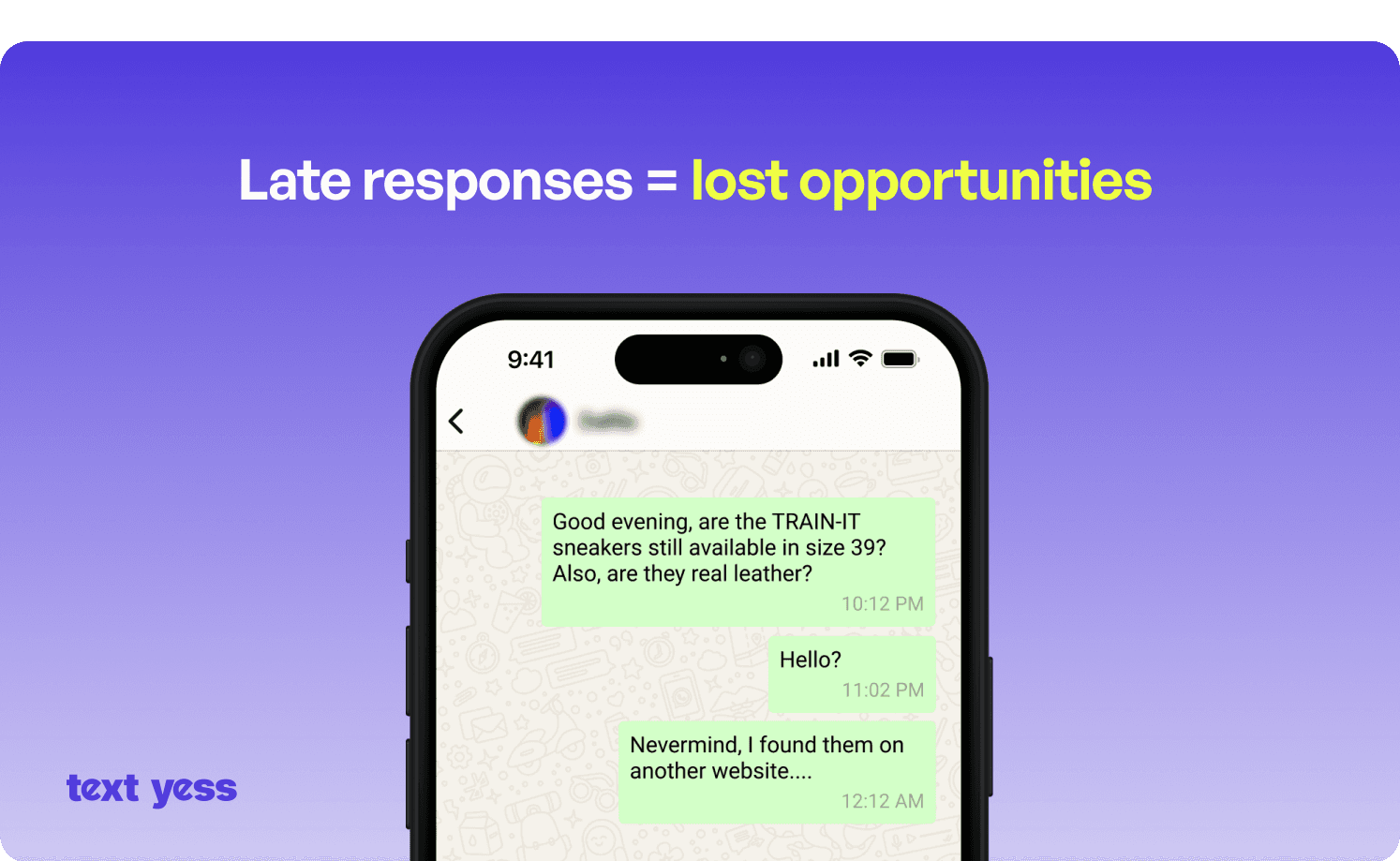
Shoppers browse at all hours, and with 65% expecting a response within 5 minutes, questions that go unanswered often mean lost sales. A WhatsApp solution provides 24/7 shopping assistance regardless of time zone or staffing, capturing revenue from late-night browsers and international customers alike.
Modern AI chatbots analyze browsing behavior, purchase history, and conversation context to recommend relevant products. This level of personalization previously required dedicated sales staff. Now it happens automatically across thousands of simultaneous conversations.
Automating answers to common questions like shipping times, return policies, or size guides, frees human agents for complex issues. Response times drop from hours to seconds.
When evaluating platforms, certain capabilities separate tools that drive revenue from tools that simply respond to messages.
The difference between a basic bot and an effective one often comes down to natural language understanding. Quality platforms interpret customer messages even with typos, informal language, or unexpected phrasing—then respond with relevant information rather than generic fallbacks.
A chatbot that can't access your product catalog, inventory levels, and order data is essentially a fancy FAQ. Direct integrations with Shopify, WooCommerce, or Magento enable real-time product recommendations and accurate order status updates.
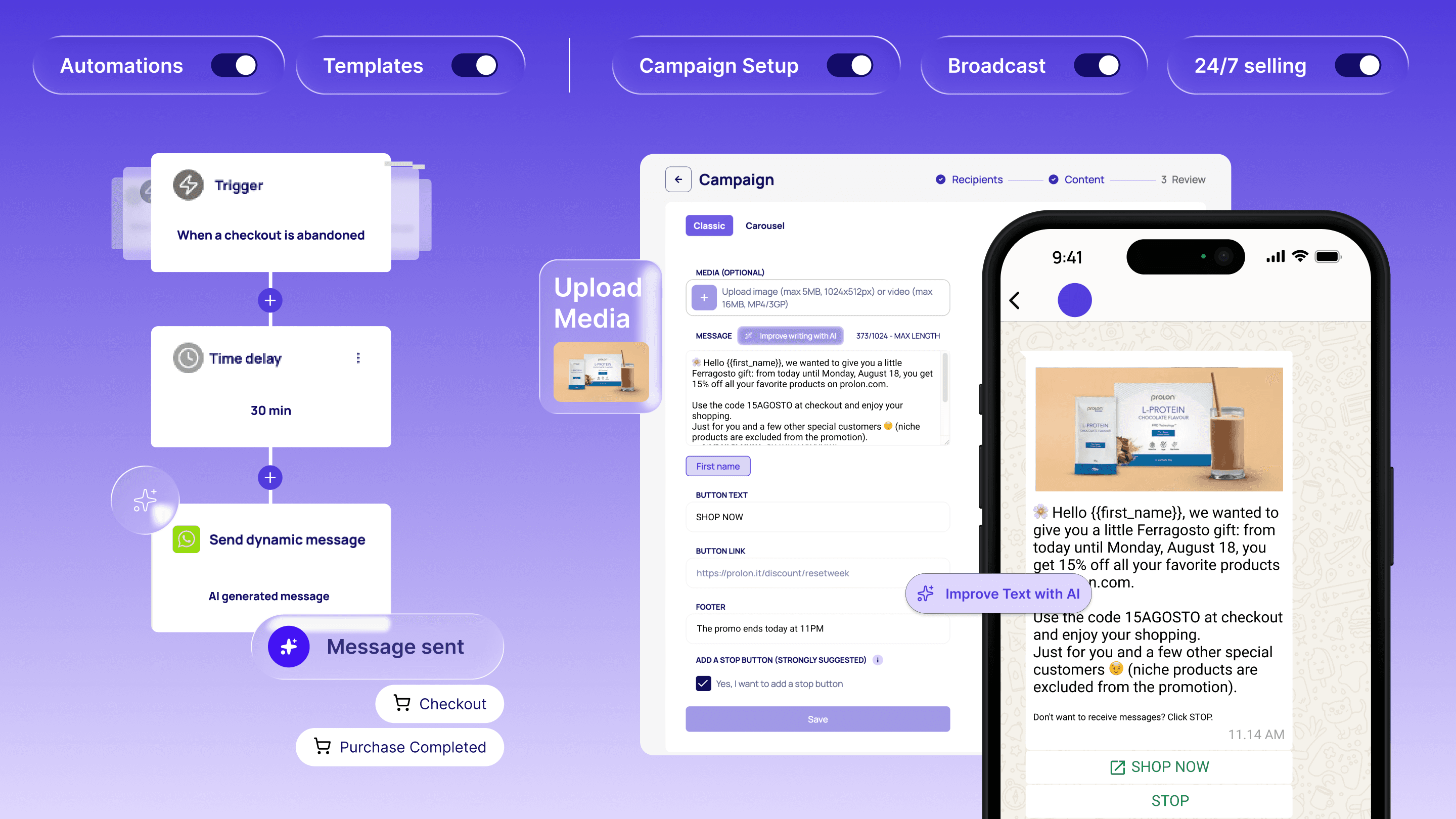
Proactive messaging that reminds shoppers of items left behind is one of the highest-ROI features available. The best platforms send personalized recovery messages within an hour of abandonment, include the specific products, and make it easy to complete checkout directly in the conversation.
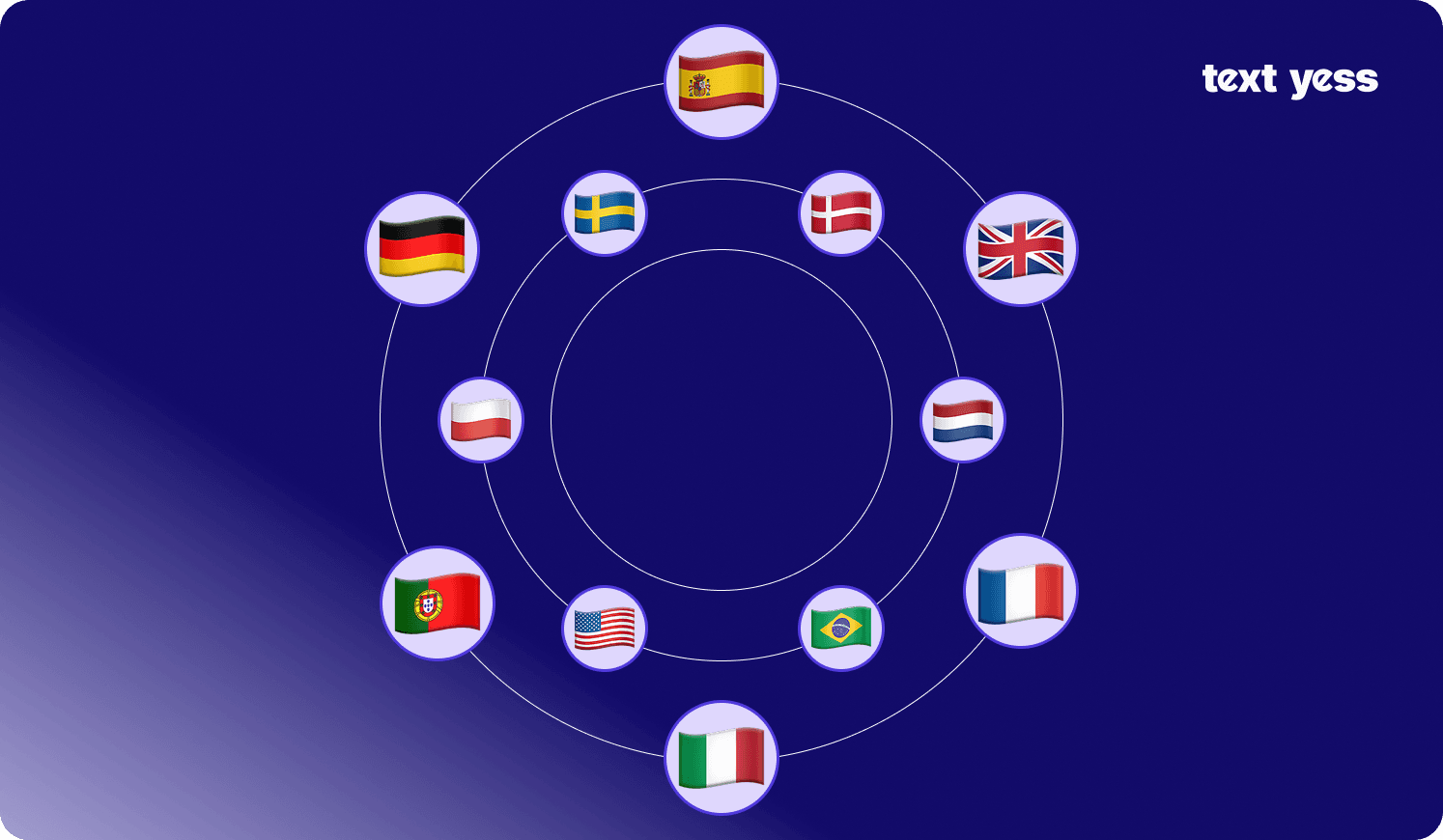
For brands selling across EU markets, conversations that feel local drive higher conversion. Platforms like TextYess handle multi-language conversations that adapt naturally to each customer's language preference.
Understanding which conversations lead to orders is essential for optimization. Look for platforms that track conversation-to-conversion rates and revenue per interaction—not just message volume or response times.
The best platforms enable non-technical teams to configure conversation flows, update product knowledge, and launch campaigns without developer resources.
Platform | Best for | AI capabilities | Ecommerce focus | Free plan |
|---|---|---|---|---|
TextYess | Revenue-focused brands | Advanced AI agents | Purpose-built | Demo available |
ManyChat | Marketing automation | Rule-based + AI ⚠️ | Moderate | Yes |
WATI | Support teams | Basic AI ⚠️ | Moderate | No |
Tidio | Small-medium stores | Lyro AI | Good | Yes |
Gupshup | Enterprise/custom builds | Developer-focused | Flexible | No |
Charles | EU WhatsApp marketing | Moderate | Strong | No |
Landbot | Visual flow building | Rule-based ⚠️ | Limited | Yes (no WhatsApp) |
Chatfuel | Quick deployment | Template-based ⚠️ | Moderate | Yes |
TextYess is an AI-first conversational platform built specifically for ecommerce revenue. Unlike general-purpose chatbot tools, TextYess treats WhatsApp as a sales channel rather than just a support inbox.
Best for: Ecommerce brands wanting measurable revenue from conversational channels, particularly brands selling across EU markets.
Key features: Unified inbox across WhatsApp, website chat, and voice; deep Shopify and WooCommerce integrations with real-time product sync; proactive abandoned cart recovery; revenue attribution that ties conversations directly to orders; multi-language support.
Pros: Purpose-built for ecommerce conversion; no-code setup that can go live in minutes; clear ROI tracking.
Cons: Focused on ecommerce, not ideal for non-ecommerce use cases.
ManyChat started as a Facebook Messenger tool and has expanded to WhatsApp, Instagram, and SMS. The platform is particularly strong for marketing automation and lead generation with a visual flow builder.
Best for: Brands prioritizing marketing automation and multi-channel campaigns.
Key features: Visual drag-and-drop flow builder; multi-channel support; Shopify integration for basic product data; broadcast messaging and drip campaigns.
Pros: Intuitive interface; strong template library; affordable entry point with free tier.
Cons: More rule-based than AI-native, struggles with unexpected queries; ecommerce integrations less deep than specialized platforms.
WATI (WhatsApp Team Inbox) is an official WhatsApp BSP focused on team collaboration and customer support. The platform is built around a shared inbox model where multiple agents can manage conversations.
Best for: Support teams that need collaborative inbox features and broadcast capabilities.
Key features: Shared team inbox with agent assignment; broadcast messaging; basic chatbot builder with templates; CRM integrations.
Pros: Official WhatsApp BSP with reliable API access; strong team collaboration features.
Cons: AI capabilities more basic than competitors; less focused on sales conversion than support.
Tidio combines live chat, chatbot automation, and helpdesk features in one platform. The Lyro AI assistant handles customer queries across website and WhatsApp channels.
Best for: Small to mid-size stores wanting website chat and WhatsApp coverage together.
Key features: Lyro AI for automated customer service; combined live chat and chatbot functionality; Shopify, WooCommerce, and BigCommerce integrations.
Pros: All-in-one approach reduces tool sprawl; Lyro AI handles common support queries effectively; affordable for smaller operations.
Cons: WhatsApp features limited on lower tiers; less specialized for ecommerce sales than dedicated platforms.
Gupshup is an enterprise messaging platform that provides WhatsApp API access along with tools for building custom conversational experiences. The platform is more developer-oriented than most alternatives.
Best for: Larger brands with development resources wanting to build custom WhatsApp implementations.
Key features: Direct WhatsApp Business API access; bot builder with NLP capabilities; rich messaging formats; multi-channel messaging.
Pros: Powerful for custom implementations; reliable API infrastructure at scale.
Cons: Requires technical resources to implement effectively; less turnkey than ecommerce-focused platforms.
Charles is a European conversational commerce platform focused specifically on WhatsApp marketing and catalog sales. The platform is particularly strong in German-speaking markets.
Best for: EU-based brands wanting WhatsApp marketing campaigns with strong GDPR compliance.
Key features: WhatsApp catalog integration; campaign management and broadcast tools; checkout within WhatsApp conversations; GDPR-compliant data handling.
Pros: Strong EU market focus and compliance; good for WhatsApp-native shopping experiences.
Cons: Less AI-advanced than some competitors; primarily WhatsApp-focused with limited multi-channel options.
Landbot is a visual chatbot builder known for its no-code flow design. The platform is good for creating custom conversation paths, though WhatsApp access requires higher-tier plans.
Best for: Teams wanting visual control over conversation flows without coding.
Key features: Drag-and-drop conversation builder; conditional logic and branching; integrations via Zapier; website widget and WhatsApp deployment.
Pros: Highly visual and intuitive builder; flexible for custom conversation designs.
Cons: WhatsApp only available on Pro plan and above; more rule-based than AI-powered.
Chatfuel began as a Facebook Messenger bot platform and now offers WhatsApp automation. The platform uses a template-based approach that enables quick deployment.
Best for: Brands wanting fast deployment with pre-built templates.
Key features: Template library for common scenarios; visual flow builder; Shopify integration; broadcast and drip campaigns.
Pros: Quick to deploy with templates; affordable entry point.
Cons: AI capabilities more limited than leaders; templates can feel generic without customization.
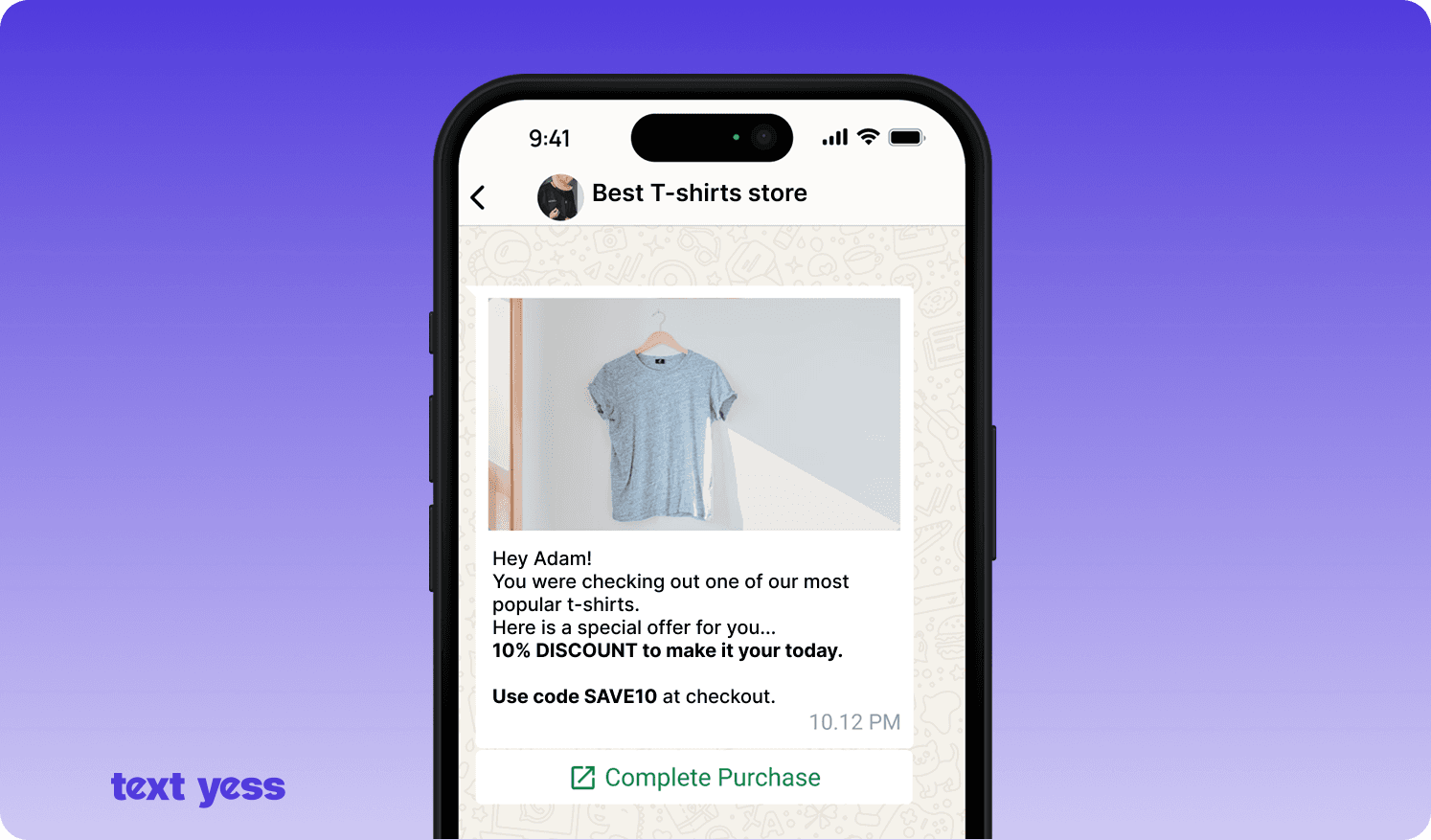
A shopper adds items to their cart, gets distracted, and leaves—something that happens at a 70.22% average abandonment rate. Within an hour, they receive a WhatsApp message with the specific items left behind and a direct link to complete the order.
Transactional messages keep customers informed without them needing to ask. Proactive updates reduce "where is my order" inquiries—often the highest-volume support question for ecommerce brands.
A customer messages asking about winter jackets. The AI asks qualifying questions—what climate, what activities, what size—then recommends specific options from your catalog with images and prices.
Common questions get instant answers: return policies, shipping to specific countries, sizing guidance. The bot handles routine inquiries autonomously, escalating to human agents only when the conversation requires it.
Broadcast messages announce sales, new arrivals, or personalized offers to opted-in customers. Because recipients can respond and ask questions directly, WhatsApp campaigns often outperform email for engagement.
A few days after delivery, the bot reaches out asking for feedback. Conversational review requests see higher response rates than email.
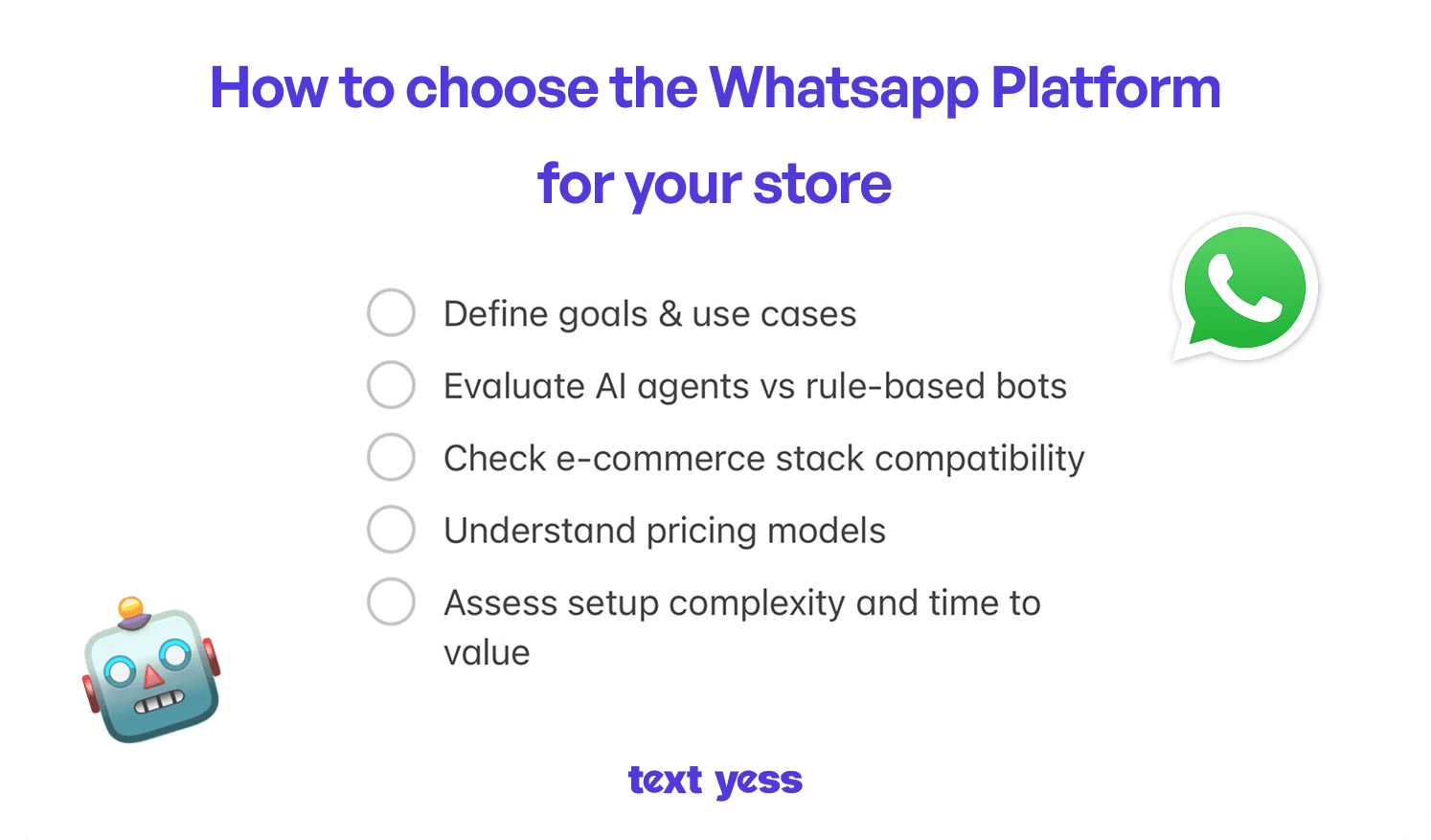
Start with what you want to achieve. A brand focused on reducing support tickets has different requirements than one trying to drive incremental sales through WhatsApp campaigns.
Rule-based bots follow decision trees: if the customer says X, respond with Y. AI-powered agents understand intent and can handle unexpected queries. For ecommerce, where customers ask questions in countless ways, AI capabilities matter significantly.
Verify the platform integrates with your specific CMS, payment processor, and marketing tools. Native integrations work better than Zapier workarounds for real-time data.
Platforms price differently: per conversation, per contact, per message, or flat monthly fees. Compare pricing models and calculate what you'd actually pay at your expected volume.
No-code platforms enable teams to launch in minutes. Developer-dependent tools offer more customization but take longer to implement.
The best WhatsApp solution for ecommerce is the one that fits your specific goals, integrates cleanly with your stack, and delivers measurable results. What separates the leaders in this space is their approach to WhatsApp as a revenue channel rather than just a support tool.
When conversations can access real-time product data, understand customer intent, and guide shoppers toward purchase, the channel becomes a genuine sales engine.
Do I need WhatsApp Business API to use a chatbot for ecommerce?
Are WhatsApp chatbots allowed for marketing messages in the EU?
Can WhatsApp chatbots process payments directly in the chat?
How do I measure the ROI of a WhatsApp chatbot for my store?
Can one WhatsApp bot platform manage both WhatsApp and website chat?
What happens when the WhatsApp AI bot cannot answer a customer question?